Expanded Steel Grating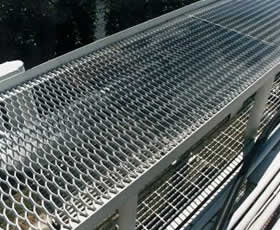 | Expanded metal grating is the most practical and economical way to assure strength, safety, and a non-skid surface. Expanded metal grating is ideal for use on plant runways, working platforms, and catwalks, as it is easily cut into irregular shapes and can be installed quickly by welding or bolting. To select the proper metal mesh for your application consult the load and deflection tables. Classification Variety: small, medium and heavy expanded metal mesh. Expanded aluminum mesh, expanded platinum filtration mesh, expanded brass mesh, expanded copper mesh, expanded stainless steel mesh, expanded nickel mesh. Opening in the shape of diamond, hexagonal or special shape. Each sheet is produced from low carbon steel plates up to 5/16" thick. The junctions of the strand and bond form a ridged surface for improved tractions. Grating is formed like a truss so that every inter-connecting strand acts as a structural member distributing the load stress in several directions across the supporting frame. The angular position of the strand and the bond makes the expanded metal grating stronger in deflection than steel plate material in original form. This product is available only in the regular or standard type and is not flattened. Typical applications include long length or catwalk grating - usually in 10 ft. lengths by 2 or 3 ft. widths. It is also ideal for flooring, platforms and stair treads, where principal use is for light storage and foot traffic. Expanded Metal Grating can be made from carbon steel, stainless steel or aluminum in styles from 1/4" to 1 1/2". |
Stainless Steel Grating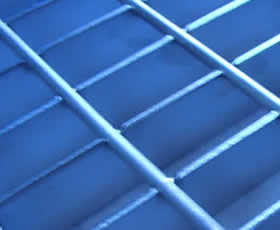 | Stainless steel grating has been the standard industrial foot walk product for severe corrosive environments and has been a popular grating choice for many years. Lingus manufactures stainless swaged bar grating from type 304 and 316 stainless steel bar. Stainless steel grating is used at chemical plants, food processing facilities, oil and gas producers and is also used in many other commercial and architectural applications. Stainless steel bar grating is a choice for corrosive environments such as chemical, food and hydro processing areas. It is available in welded and press locked as well as in many bearing bar sizes. Materials: The most common material is Type 304 (SUS304), however, Type 316 (SUS316) or Type 316L (SUS316L) is also available. 304 stainless steel is the most popular type contains both chromium and nickel to provide excellent balance resistance and workability. 316 stainless steel is better corrosion, pitting resistance and higher strength at elevated temperatures than 304. 316L is extra low carbon variation of 316 to avoid carbide precipitation due to welding. When considering grating for food processing applications, shipboard use, or highly corrosive environments, Grating Pacific Stainless Steel Grating is often the most cost effective product. Commonly manufactured in 300 series alloys, stainless steel gratings are assembled by welding or pressure locking to suit the specific needs of each application. Uses: Stainless steel bar grating is mainly used in chemical industry, food processing, hydro processing and other industries as listed: Power plant; Chemical plant; Oil Refinery; Steel plant; Machinery plant; Paper-making factory; Cement plant; Civil engineering; Wastewater treatment; |
Aluminum Grating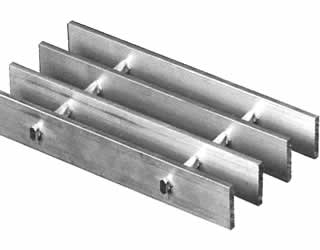 | Corrosion resistant, non-sparking, rustproof aluminum grating has many applications due to its light weight and high strength. It is ideally suited for use in corrosive environments and finds wide applications as walkways and platforms in sewage treatment plants, refineries, chemical processing plants, pumping and compressor stations, and aboard ships and barges. Because it does not rust, it is commonly used in breweries, bottling plants, and food preparation and storage facilities. In munition plants, other volatile industries and areas, its non- sparking properties make it a must for safety. It is available in standard or anodized finishes. Press-Locked Rectangular Bar Grating is constructed with the two close-tolerance slotted bars bonded together (positioned every 2" or 4") using tremendous hydraulic pressure. Permanent locking is achieved by forcing the deep cross bar into the bearing bar. Both the cross bars and the bearing bars provide walking surfaces in the press-locked design. Rectangular bar grating in either the swage-locked or press-locked styles is your best choice when lateral stiffness is required. The rectangular bar is also available in a serrated surface for additional safety. Aluminum grating is designed to be a high-strength, low-weight product that uses an I-bar or rectangular bearing bar with cross rods hydraulically swaged under high pressure. Thus, giving you a rigid, virtually maintenance-free flooring, ceiling or louvres product. Similar to steel grating, aluminum grating can be pressure locked as an alternative to swage locked. This application process also allows the customer to choose a close mesh grate where certain special needs are to be met. |
Welded Steel Grating | Welded Steel Bar Grating is the most popular of all grating types due to its strength, cost-efficient production and ease of installation. Universally used in most general industrial plants as well as commercial buildings, it has wide applications as walkways, platforms, safety barriers, drainage covers and ventilation grates. Materials: mild steel, stainless steel 304 or 316 Surface treatment: galvanizing, bitumen dipped, painted, untreated. Top surface: plain, flattened, raised. It is also ideal for use as mezzanine decking since it supports the same loads as comparable solid flooring. More than that, its cost saving openness maximizes the circulation of air, light, heat, water and sound, while promoting cleanliness. And, where insurance codes permit, additional sprinklers can often be eliminated. Standard panels are available in widths of 2', 3' or 4'. Welded steel bar grating is resistance welded to create a rugged, one-piece constructed panel. The bearing bars are automatically resistance welded at the contact point with the cross bars and, under a combination of high heat and pressure, are fused together to form a permanent joint. The cross bars provide a high degree of rigidity, yet retain a smooth flat surface for free and easy walking. When order the welded steel grating, first specify the type of grating from the table below. In the instance of standard welded grating, the "W" indicates the assembly of the grating shall be Welded construction, the "19" indicates that the bearing bars shall be 19/16's (1-3/16) inches on center, and the "4" indicates that the cross bars shall be spaced at 4 inches on center. Following selection of the type of grating, consult the Steel Bar Grating Load Table to select the appropriate bearing bar size for the loads and spans to be serviced. Proper designation for standard welded grating with 1" x 3/16" bearing bars is indicated W-19-4 1" x 3/16". |
Press- Locked Bar Grating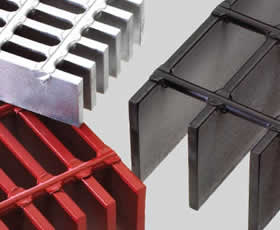 | With Press-Locked Grating the cross bars and bearing bars are notched and pressed together through a high pressure manufacturing process. The result is a bi-direction flush surface that assures a firm, rigid connection and makes it aesthetically appealing for architectural applications. It is available from stock in twp bearing bars heights, in plain or corrosion-resistant galvanized steel, or aluminum. A variety of other bar heights, bar spacings and materials is available by special order. Press-Locked Rectangular Bar Grating is constructed with the two close-tolerance slotted bars bonded together (positioned every 2" or 4") using tremendous hydraulic pressure. Permanent locking is achieved by forcing the deep cross bar into the bearing bar. Both the cross bars and the bearing bars provide walking surfaces in the press-locked design. Rectangular bar grating in either the swage-locked or press-locked styles is your best choice when lateral stiffness is required. The rectangular bar is also available in a serrated surface for additional safety. Press-Locked Steel Bar Grating is often desirable because of its clean, smooth look and excellent lateral support. It exhibits the same strength, long life and openness as welded grating, although it is not recommended for rolling loads. Instead of welding the joints, however, tremendous hydraulic pressure is used to bond the two close-tolerance slotted bars together. Permanent locking is achieved by forcing the deep cross bar into the notched bearing bar. |
